The rising stem knife gate valve handles tough jobs. You see its stem move upward when open. This design cuts through thick materials. Its sharp edge slices slurries, sludge, and fibrous matter.
This valve provides reliable isolation. Standard valves clog with sticky substances. The knife gate valve does not. It suits highly viscous fluids and solids-laden media.
How does this design achieve tight shutoff? The stem and gate rise together. You see the position clearly. This visual indicator helps operators confirm the valve state.
Knife gate valves differ from standard gate valves. Their blade-like gate slices through buildup. This action ensures dependable sealing every cycle. You get consistent fluid flow control.
The article explains the working mechanism, key components, types, and applications. You will learn when to choose this valve.
Key Takeaways
- The rising stem knife gate valve shows its position clearly. You see the stem rise when open. This visual check saves time and keeps operators safe.
- Its sharp blade cuts through thick materials. This action stops clogs and jams. You get reliable shutoff with slurries, sludge, and fibrous matter.
- Choose the rising stem for above-ground plants. It needs vertical space. Pick a non-rising stem for tight spots or buried lines.
- Match the valve materials to your media. Check the gate, seat, and stem for chemical fit. This choice prevents early wear and leaks.
- Use this valve for on/off isolation, not flow control. For precise adjustments, pick a control valve. This gives you the right tool for each job.
What Is a Rising Stem Knife Gate Valve?
A rising stem knife gate valve pairs a sharp cutting edge with a visible moving stem. When the valve opens, you see the stem rise above the handwheel. This design gives you instant visual proof of the valve position. Operators can check the state from a distance without touching the equipment.
How Does a Knife Gate Valve Work?
The working principle relies on linear motion. The stem and gate move up and down together as one unit. When you turn the handwheel clockwise, the stem moves downwards, pushing the gate into the closed position. Turning counterclockwise raises the gate, allowing media to flow through the valve body.
The gate features a precision-ground taper that acts like a blade. This sharp edge slices through solids, fibrous materials, and slurries as the valve closes. The cutting action prevents media buildup and valve jamming. You get a clean shutoff even when handling paper pulp, sewage rags, or thick sludge.
The gate features a 15° wedge angle (tapered, sharpened edge) specifically designed to slice through solids, fibrous materials, and slurries, preventing media buildup and valve jamming. This precision-ground taper acts as a cutting blade, effectively breaking up solid agglomerates and fibrous materials such as paper pulp and sewage rags.
The rising spindle serves as your position indicator. When you see more thread exposed above the yoke, the valve is opening. When the spindle disappears into the bonnet, the valve is closing. This mechanical connection between the valve stem and gate ensures accurate positioning every cycle.
Rising Stem vs. Non-Rising Stem: Key Differences
The choice between rising stem and non-rising stem designs affects installation, maintenance, and operation. Here is a direct comparison:
| Mechanical Feature | Rising Stem (OS&Y) | Non-Rising Stem (NRS) |
|---|---|---|
| Stem movement | Travels up/down with the gate, visible externally | Stays fixed; gate travels along the stem internally |
| Position indication | Visual: stem height shows valve state | Requires an indicator, records, or other verification method |
| Installation clearance | Needs vertical space above the valve for stem travel and yoke | Compact height profile; suited to tighter footprints |
| Maintenance access | External threads and packing are generally easier to inspect and lubricate | Internal stem components can be harder to reach |
| Corrosion/contamination exposure | Operating threads sit outside the pressure boundary but still need protection | Internal threads can be affected by dirty, abrasive, or corrosive media if not properly protected |
| Typical priority | Above-ground plants needing quick visual confirmation | Underground, buried, or headroom-limited installations |
The rising stem design excels in large installations. You can see whether the valve is fully open or fully closed from across the plant floor. This visual check saves time during routine inspections. Operators do not need to climb ladders or approach hazardous areas to verify valve states.
A non-rising stem knife gate valve suits tight spaces. The valve body stays compact because the stem does not extend upward. However, you lose the visual indicator. You must rely on position sensors or manual verification to know the valve state.
For most above-ground industrial applications, the rising stem offers clear advantages. You get easier maintenance access to external threads. You can lubricate moving parts without disassembling the valve. The exposed stem also shows wear patterns, helping you schedule maintenance before failures occur.
The knife gate valve works best when you need reliable isolation in demanding conditions. Understanding how does a knife gate valve work helps you select the right configuration. Choose the rising stem design when visual confirmation matters. Choose the non-rising stem when vertical space is limited.
Key Components and Design of a Knife Gate Valve
Every knife gate valve depends on three main parts working together: the gate, the stem, and the seat. Knowing these parts helps you see how the valve stays reliable in tough jobs.
The Gate, Stem, and Seat: A Closer Look
The gate acts as the cutting blade. It has a sharp, flat edge that cuts through material as the valve closes. Gates are usually made from stainless steel to resist rust. For harder jobs, makers add hard-chrome plating, tungsten carbide, or stellite coatings to last longer. High-chrome or duplex gate materials handle the roughest slurries.
The stem links to the gate and moves it from the actuator. You can see the threaded part of the stem fit into a matching nut inside the handwheel assembly. When you turn the handwheel, the threads change spinning motion into straight-line travel. The stem then lifts or lowers the gate. Stainless steel stems fight rust, while carbon steel stems get a protective coat for strength.
The seat forms the sealing surface. You have several choices based on your media. Elastomer rings made of EPDM, Nitrile, or other materials sit on the downstream side. These soft seats give bi-directional, drip-tight shutoff. For higher pressure, one-piece cast-in-place bonded urethane liners offer great wear resistance. Metal seats work for high-heat jobs where elastomers would break down.
The design & parts of a knife gate valve also include top and bottom gland packing. This packing wraps around the stem where it leaves the bonnet. Braided PTFE or synthetic fibers keep a seal against leaks while letting the stem move smoothly. You can adjust the packing tightness to handle wear over time.
Actuation Methods: Manual, Pneumatic, and Electric
You have several ways to run your knife gate valve. Each method turns rotational or straight-line input into the vertical stroke needed to lift or seat the gate.
Manual operation uses a handwheel mounted on top of the yoke. You turn the handwheel right to close and left to open. The handwheel nut grabs the stem threads, changing your spin into exact straight-line movement. Manual actuation works well for valves you use rarely or where automation is not needed.
Pneumatic actuation uses compressed air to drive the valve actuator. The process follows a simple order:
- Compressed air enters the actuator cylinder at normal pressures of 4-8 bar (60-115 PSI).
- The air pressure pushes against an inner piston or diaphragm.
- The piston force moves the connected stem and gate straight to open or close the valve.
You can pick between two pneumatic setups. Double-acting actuators use air for both opening and closing, giving steady force both ways. Single-acting spring-return actuators use air to press a spring and open the valve; if air fails, the spring automatically returns the gate to a safe spot.
Electric actuation uses a motor-driven valve actuator that turns a gear train linked to the stem nut. You get exact position control and easy hookup with automated control systems. Electric actuators fit remote sites where compressed air is not available.
TANGGONG VALVE offers a range of actuation options across its knife gate valves series. You can select manual, pneumatic, or electric setups based on your needs and control system fit.
The actuation choice affects your setup cost, upkeep needs, and operating flexibility. Manual valves cost less upfront but need operator attention. Pneumatic valves react fast and offer fail-safe choices. Electric valves give exact control but use more energy.
For slurry work in mining, you should check your knife gate valves daily during routine rounds. Replace seals and worn parts before failure happens to cut downtime. A case study from a gold mine in Western Australia showed this idea: old slurry gate valves lasted only 7 to 10 days before needing repair, costing over $43,000 per month in lost output. After switching to purpose-built knife gate valves, the new valves stayed in service after 8 months without fixes.
Your upkeep schedule depends heavily on valve design and slurry conditions. Picking valves made specifically for slurry service extends their lifespan a lot.
Types and Variations of Knife Gate Valves
Knife gate valves come in several designs. Each type serves a specific job. You must pick the valve that fits your pressure needs and installation limits.
Body Styles: Wafer, Lug, and Flanged
The body style controls how you install the valve in your pipeline. Three main choices exist: wafer, lug, and flanged.
Wafer-type valves sit between two pipe flanges. Long bolts pass through the flange holes and hold the valve in place. This design saves space in tight spots. You get a small, light option for short to medium pipelines. Wafer bodies work well in wastewater systems where space is tight.
Lug-type valves have threaded inserts around the body. You bolt the valve straight to the pipe flanges. This design allows dead-end service. You can take off downstream piping while upstream pressure stays contained. The valve holds pressure safely because it stays bolted to the upstream pipe. This creates a leak-proof link for maintenance areas. You can fix downstream equipment safely without releasing pressure from the upstream line.
Flanged valves have flanged ends that bolt straight to matching pipe flanges. This setup handles stronger pipeline forces and alignment needs. Flanged bodies fit large sizes, high pressure, and heavy industrial lines. You get solid connection stability for tough jobs.
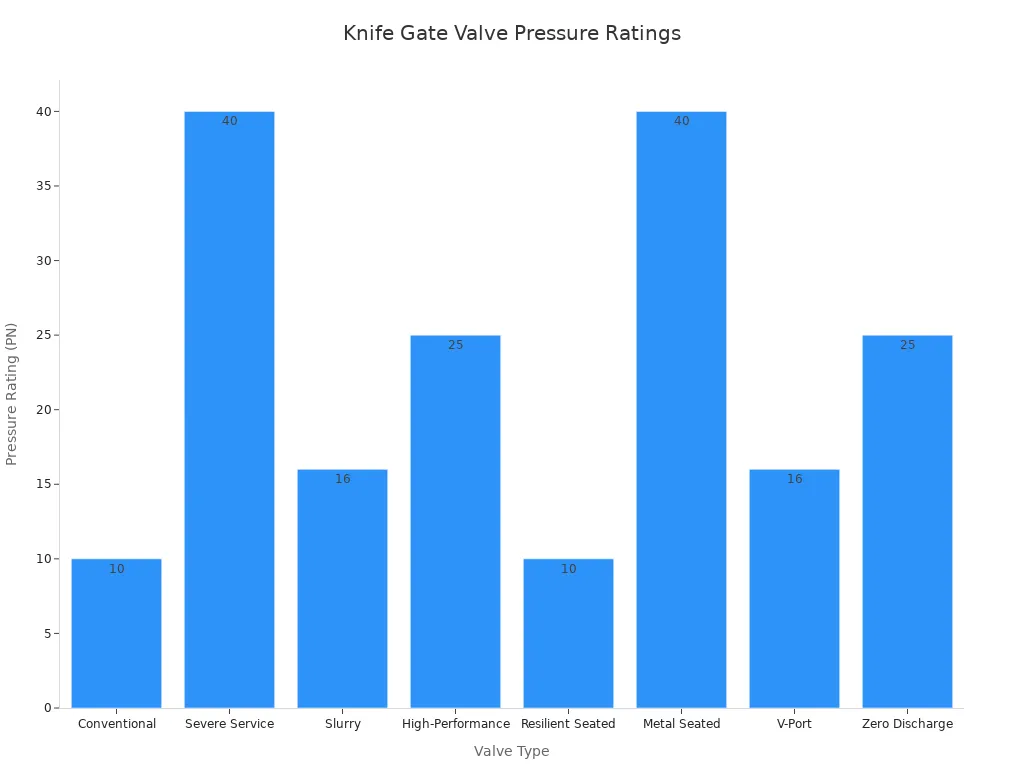
The table below shows the pressure ratings for different types of knife gate valves:
| Valve Type | Pressure Rating (PN) |
|---|---|
| Conventional | 10 |
| Severe Service | 40 |
| Slurry | 16 |
| High-Performance | 25 |
| Resilient Seated | 10 |
| Metal Seated | 40 |
| V-Port | 16 |
| Zero Discharge | 25 |
PN 10 equals about 150 psi.
Sealing and Connection Options
Your seat material controls how well the valve stops fluid leaks. You have two main choices: resilient seats and metal seats.
Resilient seats use rubber-like materials such as EPDM or Nitrile. These soft seats give drip-tight shutoff. They handle solids-filled media well because the flexible material soaks up impact. Resilient seats fit lower pressure jobs rated at PN 10. You get great sealing performance for wastewater and slurry work.
Metal seats offer toughness for high-heat and rough conditions. They handle pressures up to PN 40. Metal seats resist wear from sand, scale, and other hard bits. You give up some sealing tightness compared to resilient seats, but you gain longer life in harsh places.
For large size or high pressure valves, you must leave enough installation space. The actuator needs room to work. You also need clearance for lifting and maintenance gear.
Knowing the types of knife gate valves helps you pick the right setup. Think about your media, pressure, and space limits. The correct choice stops early wear and ensures steady operation.
Applications and Industry Use Cases
The rising stem knife gate valve works well in industries where regular valves fail. You will see it handle thick slurries, fibrous sludge, and rough materials with steady performance. Its cutting action and straight-through design make it the top pick for tough isolation or on/off jobs.
Handling Slurries and Solids in Mining and Wastewater
Mining work pushes equipment hard. You deal with rough tailings, thick slurries, and solids that wear down normal valves fast. The knife gate valve‘s sharp blade cuts through these materials when closing. This cutting action stops particle buildup and keeps the valve sealing well every time.
Wastewater plants face a different issue: high-fiber sludge. Rags, plastics, and fibrous materials clog regular valves. The knife gate valve fixes this with its full-bore design. When open, the gate pulls back completely from the flow path. Media moves through with little resistance and very low pressure drop. The straight-through flow path cuts down sludge clogging, while rubber or ceramic sealing surfaces stop leaks.
You get several key benefits in these places:
- Cutting action: The blade-like gate slices through solids when closing, stopping fiber buildup.
- Full-bore design: The gate pulls back fully, letting thick media pass smoothly and reducing sticking.
- Tight shutoff: Soft seats provide drip-tight sealing even with solids present.
For mining work, you should check the gate material and edge condition. Stainless steel handles rust, but high-chrome or coated gates resist wear better. Separate corrosion risk from abrasion risk when picking your valve.
Demanding Media in Pulp and Paper and Chemical Processing
The pulp and paper industry uses knife gate valves for fiber-rich slurry control. The knife edge cuts through pulp fibers easily, preventing tangles that would block the valve. You get smooth pulp movement through your pipes without clogging stops.
Pulp thickness determines your valve choice. For medium stock between 2–6%, metal-seated knife gate valves work best. They handle full-reverse pressure and last longer with no rubber to fail. For white-water jobs below 2% thickness, perimeter soft-seated valves give bubble-tight shutoff and two-way service.
Chemical processing adds another layer of difficulty. Your wet parts may see water, pulp fiber, fillers, sizing chemicals, caustic cleaners, and bleaching agents. You must check all wet components, not just the body. Look at the gate, stem, seat, packing, fasteners, and trim for chemical compatibility.
Bleaching processes need higher alloy metals or soft liners. Confirm rubber seat compatibility with your specific chemicals and heat limits. Include cleaning cycles and upset conditions in your valve spec. A valve chosen for normal use may not survive periodic chemical cleaning or heat spikes.
For jobs needing exact flow control rather than isolation, TANGGONG VALVE’s control valve series offers another option. These valves give steady throttling control for process factors like flow, pressure, and temperature. You get the right tool for every job: knife gate valves for isolation, control valves for adjustment.
Weighing the Pros and Cons
Every valve design has trade-offs. You must weigh the benefits against the drawbacks before choosing. The rising stem knife gate valve offers clear advantages for tough jobs, but you also need to think about installation limits and material compatibility.
Key Advantages of the Rising Stem Design
The rising stem design gives you a clear mechanical benefit: you can see the valve position. You look at the stem height directly. No guesswork needed. This feature proves valuable in large industrial plants where operators watch many valves across wide areas.
| Aspect | Conventional Method | Visual Position Indication |
|---|---|---|
| Position verification | Depends on electrical limit switch signals only | Checks stem position on its own, catching sensor-confirmed-open but mechanically-stuck-closed failures |
| Hazardous area monitoring | Needs manual inspection rounds | Fixed visual checks remove routine personnel exposure |
| Fault detection timing | Finds issues after functional failure | Finds partial-open, misalignment, or corrosion before failure |
Visual verification confirms the actual mechanical position of the valve stem directly from the image — independently of the electrical signal. This catches failures where the control system receives a valid position signal while the valve is not actually in the commanded position.
The knife gate valve also excels at cutting through fibrous materials. The sharp blade edge slices through rags, pulp, and sludge during closure. This cutting action prevents clogging and ensures reliable shutoff every cycle. You avoid the jamming problems that plague standard gate valves in solids-laden service.
TANGGONG VALVE manufactures these valves to strict quality standards. You get durable construction that withstands abrasive media and repeated cycling. The rising spindle shows wear patterns visibly, helping you schedule maintenance before failures occur.
Limitations and Considerations for Selection
The rising stem design requires vertical clearance above the valve. You need space for the stem to travel upward when opening. Tight installations may not accommodate this height. Measure your available space before specifying this valve type.
Material selection demands careful attention. You must match the gate, seat, and body materials to your specific media. Chemical compatibility matters for every wetted component. A valve that works for slurry may fail with corrosive chemicals. Check the seat material against your process fluids and temperature ranges.
Fluid leakage prevention depends on proper packing adjustment. You must maintain the gland packing around the stem. Regular inspection and tightening keep the seal effective. Neglect this maintenance and you risk leaks developing over time.
The initial cost of knife gate valves exceeds standard gate valves. You pay more upfront for the specialized design. However, the longer service life and reduced downtime often offset this higher investment. Consider your total lifecycle costs, not just the purchase price.
For applications requiring precise flow modulation rather than isolation, consider TANGGONG VALVE’s control valve series. These valves provide continuous throttling control for process variables. You get the right tool for each job: knife gate valves for isolation, control valves for adjustment.
The rising stem knife gate valve works well for tough materials. You can see the valve position clearly, and its blade cuts through solids. This design seals tightly where regular valves fail because of clogs or wear.
When picking a valve, think about your material type, pressure, temperature, and space limits. The rising stem needs room above it for the stem to move up. Ask yourself if seeing the valve position matters for your work.
This valve shows its strength in key industrial jobs. Companies like TANGGONG VALVE make different versions to fit your needs. Choose the knife gate valve for shutoff tasks with slurries, sludge, or fibrous materials. You get longer life and less downtime.
FAQ
How often should I inspect my rising stem knife gate valve?
In slurry or abrasive service, check your valve daily during routine rounds. Look at the exposed stem for wear patterns and corrosion. Make sure the gland packing stays tight. Replace worn seals before failure happens to avoid costly downtime.
Can a knife gate valve handle corrosive chemicals?
Yes, but you must match all wetted parts to your specific media. Check the gate, seat, body, packing, and fasteners for chemical compatibility. Rubber seats may break down with certain solvents or high temperatures. Metal seats handle more heat but may not seal as tightly.
What pressure ratings are available for knife gate valves?
Pressure ratings vary by valve type. Conventional valves handle PN 10, about 150 psi. Severe service and metal-seated valves reach PN 40, roughly 600 psi. Slurry and V-port valves rate at PN 16. High-performance and zero-discharge valves handle PN 25. Choose based on your system pressure.
Do I need special clearance for a rising stem design?
Yes, you need vertical space above the valve for the stem to move upward when opening. Measure your available height before installation. Tight spaces may require a non-rising stem design instead. Remember to include room for actuator maintenance and lifting equipment.
What is the difference between a knife gate valve and a control valve?
A knife gate valve provides on/off isolation with a cutting action for solids-laden media. A control valve modulates flow continuously to maintain process variables like pressure or temperature. Use knife gate valves for shutoff tasks. Use control valves when you need precise throttling control.