
A slurry knife gate valve is a heavy-duty shutoff valve that works with rough, gritty, stringy, and thick materials. A sharp knife-edge disc slides down through the flow path to cut through solids and stop the flow. When the valve opens, the disc lifts out of the media path. This design works well for tough industrial jobs where normal valves clog or wear out fast. The knife edge cuts through material instead of pushing it aside. That cutting action keeps the flow path clear while the valve closes. The valve body stays narrow so solids cannot build up inside. These features make the valve reliable in hard conditions.
Key Takeaways
- A slurry knife gate valve uses a sharp blade to cut through thick materials and stop flow.
- The valve’s design prevents clogs and wears less in tough jobs.
- It seals tightly in both directions to handle backflow.
- Choose this valve for abrasive particles, high solids, or stringy fibers.
- Regular maintenance keeps the valve working and extends its life.
How a Slurry Knife Gate Valve Works
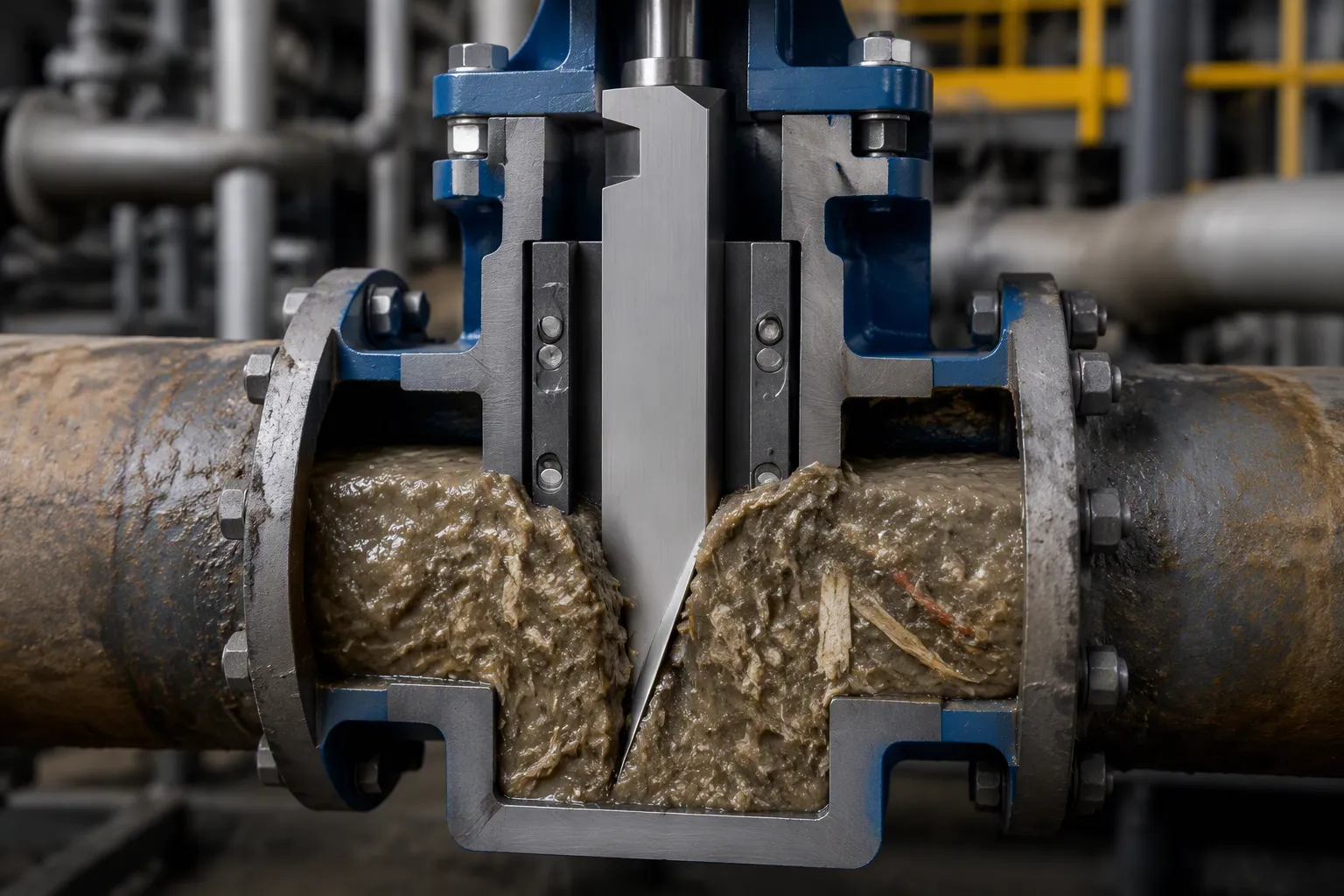
A slurry knife gate valve uses a sharp metal disc that moves straight up and down. The blade cuts through solids, fibers, and thick liquids instead of pushing them away. Side guides keep the disc in line. At the bottom of its travel, the blade presses against the seat and shuts off the flow. This straight movement gives the cutting force. The guides also stop the blade from sticking.
Knife-Edge Shearing Action
The main feature is the beveled edge that gives the valve its name. This edge is ground to a sharp point. Its job is to cut, not just to seal. The blade is thinner than a plug or disk, so it moves less material as it closes. Normal valves push thick material away and clog. This valve cuts through instead. The blade moves down and splits the material apart. It handles pulp, ash, powder, and stringy fibers easily. These materials often stop standard valves from working.
The valve body has no bonnet cavity or seat pocket. The bottom is flat and smooth, with no spots for solids to settle. As the blade closes, it pushes blocking material out of the way. This open design keeps the valve working in tough service. Without it, solids would pack into the body and stop the gate.
Blade shape matters for high-solids service. When slurries have more than 40% solids by weight, or particles are bigger than 5 mm, the blade needs extra strength and wider gaps. A stronger edge cuts these materials instead of squeezing them, which stops jamming and lowers seat wear. The gate edge splits material as it moves down, clearing solids from the sealing area. This stronger edge resists damage from hard particles. This also makes the seat last longer. Valves last longer with this design.
The gate edge enters the slurry and splits material as it moves down. Because the blade is thinner than a plug or disk, it moves less material.
Sealing and Shutoff
After the blade finishes its travel, the valve must hold tight. The sealing system must give drip-tight shutoff in both directions. This two-way isolation matters for slurry lines with backflow. Two seat designs are common in a slurry knife gate valve. Compression-loaded elastomer sleeves work well for abrasive service and seal up to 150 psi. These sleeves fit the blade edge. Rotatable seat rings handle high-pressure slurries up to 740 psi and spread wear evenly. The rotatable rings make seat life longer in harsh conditions.
The body sealing surface has no grooves, so solids cannot collect there. An elastic strip on the gate presses against this smooth surface when the valve closes. This stops sediment from packing into the valve cavity. It also keeps the sealing line clean for the next cycle.
When the valve opens, the gate pulls back fully out of the flow path, opening the pipe bore. This makes a large opening in the top of the body, sealed by a rectangular packing arrangement. The packing wraps around the blade, stops leaks, and handles constant friction. The packing must match the blade’s rectangular shape. It stops spray and drips. This mix of sharp cutting edge, clean body cavity, and strong sealing system makes the valve reliable for isolation duties.
Key Components of a Slurry Knife Gate Valve
Body, Blade, and Seat
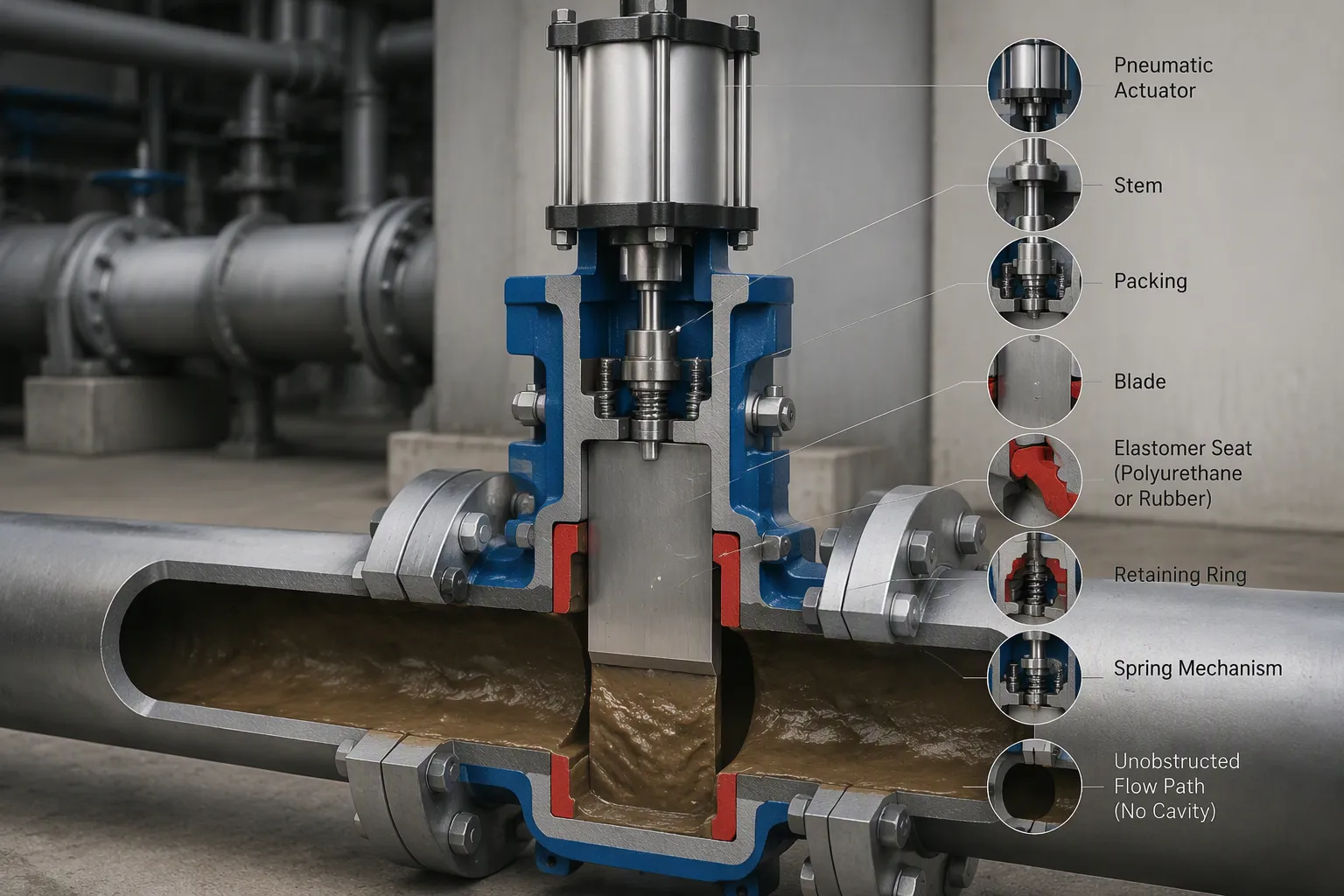
The body of a slurry knife gate valve is slim. This shape leaves no space for solids to gather. A normal gate valve has a cavity where grit packs in and stops the gate from moving. The slurry design takes that cavity away. The flow path stays open and clear.
Body material must fit the service. Common choices include:
- Cast iron
- Ductile iron
- Stainless steel
Ductile iron takes pressure and shock better than standard cast iron. Stainless steel fights corrosion in chemical slurries. The right pick depends on how abrasive the media is and the working conditions.
The blade is a sharp-edged sliding gate. It moves straight down to cut through material. The seat is the part that seals against the blade edge. Elastomer seats fit the blade edge and give a tight shutoff. Common seat materials are EPDM, NBR, and metal. Polyurethane seats with a hardness of Shore A 95 or higher work well in abrasive media. In abrasive slurry lines, polyurethane-seated valves extend service life by 300% compared to rubber seals.
Seat retention matters for a good seal. Several methods stop seat deformation during knife-edge gate closure:
| Seat Retention Method | How It Prevents Seat Deformation |
|---|---|
| Press-fitting metal seats into the body | Secures the seat so it cannot shift when the gate closes |
| Spring-loading the seat | Compensates for thermal expansion and wear |
| Retaining rings on PTFE/urethane seals | Prevent seal displacement during operation |
| Honed seat pockets (H7 tolerance, 0–+0.03mm) | Ensure uniform blade contact and avoid stress points |
| Blade preload adjustment (0.1–0.2mm) | Provides controlled contact force against the seat |
| Urethane seal elasticity | Compensates for minor blade wear without deforming the seat |
Stem, Actuator, and Packing
The stem links the blade to the actuator. It moves the blade up and down. Actuator options include manual handwheels, pneumatic cylinders, and electric motors. Manual operation suits low-cycle duties. Pneumatic and electric actuators handle automated service and remote control.
The packing seals the area where the stem exits the body. A rectangular packing arrangement wraps around the blade. This stops leaks when the gate retracts. In slurry service, fine particles can migrate into the stuffing box and act like sandpaper on the stem. This causes scoring, packing wear, and leaks.
A lantern ring packing configuration solves this problem. It uses lower packing rings, a lantern ring, and upper packing rings. A drilled port on the bonnet allows flush fluid injection. Clean water enters at a pressure slightly above the pipeline pressure. This creates a barrier that pushes abrasive particles away from the packing and stem. The lantern ring also enables lubricant injection. This reduces operating torque and prevents stick-slip behavior in automated valves.
TANGGONG VALVE offers a broad industrial valve portfolio, including knife gate valves for demanding service. The company applies strict quality control and advanced manufacturing to produce valves for abrasive and corrosive environments.
Design Features for Slurry Service
Full-Bore Flow Path
With a full-bore flow path, slurry travels through a straight, open channel in the valve. The valve opening matches the pipe size. This design keeps pressure loss very low. Thick slurries move through without slowing down or building up. A smaller bore would form a bottleneck. Solids would gather there and plug the line.
The valve body has no pockets or hollows, so material cannot settle there. When the blade lifts, the channel stays fully open. This matters for thick slurries with lots of solids. It also helps with stringy materials that tangle. A clear path lets the line keep running without constant flushing.
Materials and Wear Resistance
How long a slurry knife gate valve lasts depends on the material used. Abrasive materials wear down soft metals. Corrosive materials eat into regular steel. Makers use wear-resistant alloys, elastomer linings, and corrosion-resistant coatings to fight both issues.
The blade material is the most important pick. The table below lists common choices for abrasive service.
| Alloy/Coating | Base Material | Hardness | Best Suited For | Wear Performance |
|---|---|---|---|---|
| Stainless Steel (304/316) | Stainless steel | ≥45 HRC | Corrosive media with some solids | Standard wear resistance |
| Stellite 6 Surfacing | Alloy steel | ≥58 HRC | Highly abrasive media (mining tailings, coal ash) | 70% less wear than uncoated steel; 0.1mm wear after 10,000 cycles in mining tailings pipeline |
| Tungsten Carbide Coating | Optional coating | ≥85 HRA | Extreme abrasion (quartz sand slurries) | Unmatched wear resistance; 70% less wear than uncoated steel |
Stellite 6 and tungsten carbide coatings make blades last from 2–3 years to 8–10 years in abrasive slurries. Elastomer linings like polyurethane or rubber protect the body from wear. Corrosion-resistant coatings add another layer of defense.
TANGGONG VALVE uses strict quality control and modern manufacturing to build valves for abrasive and corrosive industrial settings.
Slurry Knife Gate Valve vs. Standard Knife Gate Valve
Where the Designs Diverge
A standard knife gate valve works with clean liquids and light slurries. Its blade is thinner, its packing is lighter, and its seat is often metal-to-metal. A slurry knife gate valve adds strength where abrasive media attack the valve. The blade is reinforced and sometimes hardened with wear-resistant alloys. The packing is heavier and often uses a lantern ring to keep grit away from the stem. The seat is usually an elastomer that shapes itself to the blade edge.
Seat design is the biggest difference. Metal seats fight abrasion through hardness, but fast-moving grit scrapes the seating surface and causes leakage. Metal-to-metal seals can also get coated with paste or scale, which leads to seizure. Elastomer seats work in a different way. The elastomer bends and soaks up the energy of abrasive particles instead of wearing away. This gives sealing in both directions, and perimeter-seated designs keep a tight shutoff even with heavy grit. The gate also pushes debris out of the seating area as it closes, so the valve cleans itself.
| Attribute | Elastomer Sealing | Metal Seating |
|---|---|---|
| Wear mechanism | Absorbs impact from particles | Resists abrasion through hardness |
| Abrasive attack | Resilience absorbs particle energy | Grit scours the seat and causes bypass leakage |
| Sealing behavior | Bidirectional, tight shutoff with heavy grit | Can seize when paste or scale encrusts the seal |
| Self-cleaning | Gate pushes debris out during closure | Dead pocket can trap hard debris |
| Failure consequence | Seal and body can suffer damage from high-velocity leakage | Scarred gate and seats raise replacement costs |
When to Specify a Slurry Version
Your choice depends on four things: media abrasiveness, solids content, viscosity, and isolation duty. A slurry knife gate valve fits lines with abrasive particles, high solids content, thick or stringy media, and a need for reliable sealing in both directions. A standard knife gate valve may work for clean liquids, light suspensions, and low-cycle on/off duty. When particles are sharp or the line runs nonstop, the reinforced blade, heavier packing, and elastomer seat pay back the higher upfront cost through longer service life.
A slurry knife gate valve is a heavy-duty shutoff valve with a sharp disc. The disc slices through solids, fibers, and thick liquids. The knife edge cuts material as it closes, and the sealing system gives a tight shutoff in both directions. Its slim body, elastomer seat, rectangular packing, full-bore path, and wear-resistant materials make it reliable in abrasive service. These features keep the flow path clear and extend valve life. Mining, wastewater treatment, pulp and paper, and power generation all depend on this design for tough shutoff duties.
FAQ
What industries use a slurry knife gate valve?
Mining, wastewater treatment, pulp and paper, and power generation all depend on this valve. These industries deal with abrasive, fibrous, or thick materials. The knife-edge design cuts through solids and keeps lines moving. Standard valves often clog or wear out quickly in these conditions.
How does a slurry knife gate valve differ from a standard knife gate valve?
The slurry version has a stronger blade, heavier packing, and an elastomer seat. A standard knife gate valve uses a thinner blade and lighter construction. The slurry design handles abrasive particles and high solids content. It also seals tighter in both directions.
What actuator options work for slurry knife gate valves?
Manual handwheels work well for low-cycle jobs. Pneumatic cylinders and electric motors handle automated service and remote control. The actuator choice depends on how often the valve cycles and whether remote operation is needed. All options move the blade up and down through the flow path.
How do you maintain a slurry knife gate valve?
Regular inspection of the blade edge and seat keeps the valve working. Operators should check packing for wear and tighten or replace it as needed. Flushing the lantern ring area removes grit that causes stem scoring. Replacing worn elastomer seats restores tight shutoff.
When should you choose a slurry knife gate valve over a standard one?
Choose the slurry version for abrasive particles, high solids content, thick media, or stringy fibers. It also fits lines that need reliable sealing in both directions. A standard knife gate valve works for clean liquids and light suspensions. The slurry design pays back its higher cost through longer service life.