A PFA lined valve is an industrial valve with a metal body protected by a PFA lining. This lining keeps corrosive chemicals away from the metal. The metal gives strength, the lining forms a chemical barrier, and the fluid only touches the lining. Think of a waterproof jacket over a sturdy frame: the frame holds the shape, and the jacket takes the weather. These valves handle harsh chemicals safely, stay pure, and outlast unlined metal valves. The PFA layer gives strong chemical resistance, so corrosion never reaches the body. Smooth flow paths also keep the process clean.
Key Takeaways
- A PFA lined valve has a metal body that a PFA lining protects. The lining keeps harsh chemicals away from the metal.
- PFA lining gives strong protection against chemicals and lets very little through. It stops chemicals better than PTFE, so the valve lasts longer.
- The lining stays in place because manufacturers shape it into dovetail grooves. This anchor keeps the lining tight when vacuum and temperature change.
- Different valve types work for different jobs. Ball valves are good for on/off use, and butterfly valves work well in big pipelines.
- Regular inspection and care keep the valve working well. Look for cracks, blisters, and rising torque to stop problems.
What Is a PFA Lined Valve
A PFA lined valve is an industrial valve that has a perfluoroalkoxy (PFA) lining. This protective lining keeps the metal body safe from corrosive chemicals. The liner goes all through the body and trim. Harsh chemicals never touch any metal surface. An anti-static design gets rid of built-up charges and lowers explosion risks in flammable service.
PFA in Plain Terms
PFA is a tough fluoropolymer. It is in the same family as PTFE, but it has clear advantages. The table below sums up the key properties that make PFA a strong choice for a chemical-resistant barrier.
| Property | What It Means in Practice |
|---|---|
| Chemical resistance | No measurable weight change after 90 days at 150°C in 98% sulfuric acid, 70% nitric acid, and 48% hydrofluoric acid; tensile strength retention above 95% |
| Permeation barrier | Very low gas and vapor permeation; barrier quality rises with thicker linings in hot service |
| Thermal stability | Continuous service up to 260°C, with short excursions to 280°C |
| Mechanical performance | Low compression set and good seal recovery under sustained load |
| Tribology | Low friction against stainless steel, which reduces actuation torque |
PFA melts and flows during processing. Manufacturers mold it into dovetail grooves, so the lining is physically anchored to the metal. This mechanical interlock holds the internal lining in place through thermal cycling.
Why the Lining Matters
The lining is the heart of the design. A fluoropolymer lining gives chemical compatibility across a wide range of aggressive media. Hydrocarbons, chlorinated solvents, ketones, esters, and alcohols cause little swelling. There are a few exceptions, like alkali metals and elemental fluorine at high temperature. Users should always check chemical compatibility for their specific fluid.
Permeation resistance is what sets PFA apart from older options. In tests with chlorine gas and hydrochloric acid, PFA linings showed 50% to 70% lower permeation rates than standard PTFE. PFA has a denser molecular structure with lower void content than sintered PTFE. Sintering can leave tiny voids that create pathways for small molecules. PFA melts into a continuous, almost void-free film.
PFA generally offers significantly lower permeability than PTFE; in summary tables, PTFE lining permeability is rated ‘Standard’ while PFA lining is rated ‘Lower (Superior)’.
This difference matters for corrosion protection. A permeable ptfe lining lets process media move toward the base metal over time. A dense PFA barrier blocks that path. The result is dependable corrosion resistance and longer service life. Buyers comparing a ptfe lined butterfly valve with a PFA alternative should weigh permeation behavior, not just upfront price. The same logic applies to lined ball valves and other styles. Every wetted surface depends on the lining for protection, so barrier quality drives real-world durability.
How a PFA Lined Valve Works
Key Parts Inside
A PFA lined valve has a small set of parts that work together. Each part has a clear job. The table below shows the main internal components and what each one does.
| Internal Component | Function | Key Characteristic |
|---|---|---|
| PTFE Lining | Forms an inert barrier across all wetted surfaces | Chemically inert; resists corrosion and contamination |
| Lined Ball | Regulates flow through a 90-degree rotation | PTFE-coated; rotates to open or block the flow path |
| PTFE Seats | Creates a tight seal against the ball when closed | Provides leak-proof shut-off |
| Metal Body | Supplies structural strength and pressure containment | Typically cast steel or stainless steel |
The metal body gives the valve its strength. The lining covers every wetted surface. The seats handle sealing when the valve closes. A lined ball valve uses a ball with a bore through it. A PTFE lined butterfly valve uses a different design. That design relies on a quarter-turn rotating disc mechanism. The disc sits in the pipe bore and is mounted on a rotating shaft. The disc turns 90 degrees to open or close. A ptfe-lined butterfly valve offers a compact face-to-face length. That shape saves space in tight pipe runs.
Flow Path Step by Step
Fluid enters the valve and meets only the protective layer. The closure mechanism then starts or stops the flow. In a lined ball valve, the ball rotates a quarter turn. The bore lines up with the pipe in the open position. The ball blocks the path in the closed position. In PTFE lined butterfly valves, the rotating disc swings across the bore. Quarter-turn operation makes both styles fast to actuate. A pneumatic or electric actuator turns the stem. The stem connects to the ball or disc. The operator sends a signal, and the valve moves to the commanded position. The fluid never touches bare metal at any point. This design keeps the process stream clean.
The lining stays put because of how manufacturers build it. They machine dovetail grooves into the metal body. Molten PFA flows into those grooves under high pressure. The plastic locks into the metal like a puzzle piece. This mechanical grip matters under vacuum. Negative pressure can pull a loose liner away from the wall. A dovetail anchor holds the lining tight.
Precision-machined internal dovetail grooves mechanically anchor the molten fluoropolymer under high-pressure molding, preventing lining collapse, blistering, or delamination even under continuous full vacuum (-0.1 MPa) and thermal cycling.
Older designs failed in predictable ways. Lining collapse under negative pressure was common. Blistering, delamination, and peeling also appeared. Differential thermal expansion between the metal core and the plastic jacket drove much of this damage. Modern linings use dense molding compounds plus dovetail anchoring. This combination resists negative pressure and full vacuum up to 180°C. The lining offers strong resistance to shearing forces from rapid pressure drops and hot stripping cycles.
High permeation resistance adds a second layer of protection. The barrier blocks small molecules from reaching the metal. This chemical resistance keeps the body safe over years of service.
Valve action falls into two broad groups. On/off valves, like lined ball valves, either allow full flow or stop it. Control valves throttle flow with precision. A control valve adjusts its position to hold a set rate. Lined ball valves suit isolation duty. Control valves suit processes that need fine adjustment.
Types and Applications
Lined Ball Valve and Other Types
A pfa lined valve comes in several designs, and each one fits different jobs. The table below shows the common types and where they are usually used in industry.
| PFA Lined Valve Type | Typical Industrial Applications |
|---|---|
| Ball Valve | Chemical, Oil & Gas, Pharmaceutical |
| Plug Valve | Chemical, Petrochemical |
| Butterfly Valve | Oil & Gas, Water Treatment, Power Plants |
| Diaphragm Valve | Pharmaceutical, Chemical, Food Processing |
| Gate Valve | Chemical, Petrochemical |
| Globe Valve | Chemical, Fertilizer, Power Plants |
| Check Valve | Chemical, Oil & Gas, LPG Storage |
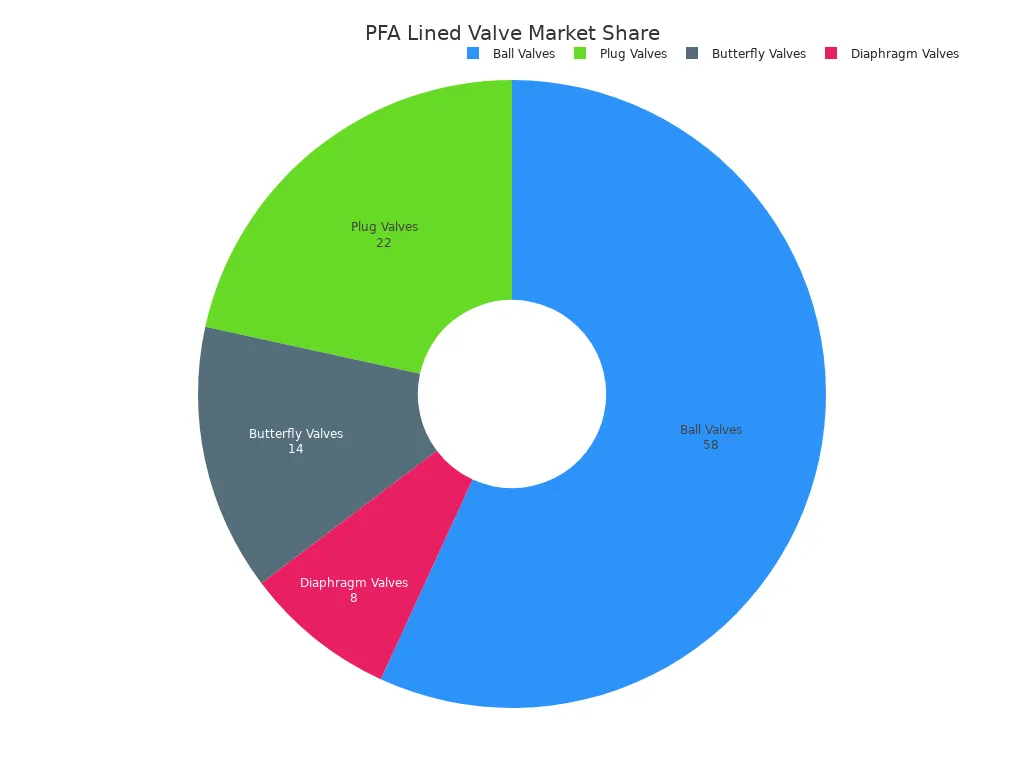
Lined ball valves are usually on/off valves that either allow full flow or stop it completely. Control valves work in a different way. They control gas or liquid in a larger system and keep it at a set rate. Ball valves hold the biggest share of this market at 58%. Plug valves come next at 22%, then butterfly valves at 14%, and diaphragm valves at 8%.
Common industries include chemical processing, oil and gas, petrochemical, pharmaceutical, water treatment, and power plants. Typical fluids include hydrochloric acid, sulfuric acid, nitric acid, caustic soda, and high-purity chemicals. Manufacturers build these valves to meet the Pressure Equipment Directive (PED).
PTFE Lined Butterfly Valve and Where Each Fits
A ptfe lined butterfly valve uses a disc that turns on a shaft. The disc turns 90 degrees to open or close the bore. Because it only needs a quarter turn, these valves are fast to actuate. A ptfe-lined butterfly valve works well in large-diameter pipelines, water treatment, and power plants. Its short face-to-face length saves space. PTFE lined butterfly valves handle acids, alkalis, and organic solvents well. They fit places that need steady operation over time with little maintenance access. PTFE lined butterfly valves also work where temperatures change.
Each type has a job it does best. Lined ball valves are great for chemical and pharmaceutical processing, where tight sealing and automated actuator hookup matter. Plug valves balance sealing and cost in mid-scale chemical work. Diaphragm valves serve sterile pharmaceutical and food duty. Check valves protect pumps and storage systems. Matching the type to the fluid and conditions gives the best result.
Benefits and Basic Care
Chemical Resistance and Purity
The biggest gain from a PFA lining is better purity and longer life. The liner does not react, so it puts nothing into the process stream. Semiconductor fabs depend on this. They send hydrofluoric acid, sulfuric acid, hydrochloric acid, and special etching chemicals through pfa-lined ball valves every day. These fluids eat most metals, including many stainless steel grades. The plastic barrier blocks them. A smooth, non-stick bore also cuts particle buildup and lets the valve be fully cleaned. Ultrapure water and reagents stay clean, and output quality stays steady.
Temperature range adds to the case. These valves run at temperatures up to +260°C, so hot acid baths and harsh chemicals fit within their range. Users still check chemical compatibility for each fluid before buying. A few media, such as alkali metals, are outside what the liner can handle. The same corrosion resistance that protects the body also protects product purity. No metal sits in the wetted path, so no metal can leach into the line.
Simple Maintenance Tips
Good care starts with routine inspection. A maintenance team checks the lining for cracks, blisters, deformation, delamination, discoloration, and abrasion. They compare what they find against process history. Localized damage usually points to flow erosion. Widespread deformation suggests temperature or vacuum exposure. Operators also watch for warning signs during service:
- Rising operating torque, which hints at seat wear or liner deformation
- External or stem leakage, and seat leakage
- Unexpected process contamination
- Changes in actuator movement or operating time
Some manufacturers add a high-voltage spark test to catch hidden liner defects before startup. Internal pressure testing and seat leakage testing round out the checks. A ptfe lining in a ptfe lined butterfly valve deserves the same attention, and so does the ptfe lining in ptfe lined butterfly valves on large lines. Follow the supplier’s guidance on inspection intervals and torque limits. Quick attention to small defects keeps sealing performance and extends service life.
A PFA lined valve is a metal valve with a PFA barrier inside. The metal carries the load, and the lining keeps chemicals off every wetted surface. Users choose it for chemical resistance, purity, durability, and safe handling of aggressive fluids. The lining blocks corrosion, and the smooth bore protects product quality.
Match the valve type to the fluid and conditions. A lined ball valve suits isolation duty, while a PTFE lined butterfly valve fits large lines. Lined ball valves and PTFE-lined butterfly valve designs each have a best-fit role. Check media, temperature, pressure, and compatibility first. A PTFE lining and PTFE lined butterfly valves reward careful selection. Ask a supplier or engineer for help. With the right choice, these valves deliver reliable flow for years.
FAQ
What makes PFA different from PTFE in a lined valve?
PFA melts into a dense film with almost no voids. Tests show it lets 50% to 70% less through than standard PTFE. That dense barrier stops chemicals from reaching the metal body. A ptfe lined butterfly valve still works well in many services, but PFA gives stronger permeation resistance for aggressive media.
How does the lining stay attached to the metal body?
Manufacturers cut dovetail grooves into the metal. Molten PFA flows into those grooves under high pressure. The plastic locks into the metal like a puzzle piece. This anchor holds the lining tight under vacuum and thermal cycling, so it resists collapse and delamination.
Can a lined ball valve handle both on/off and throttling duty?
A lined ball valve usually serves on/off duty. It either allows full flow or stops it with a quarter turn. Control valves handle throttling and hold a set flow rate. Users pick the style that matches the job, and lined ball valves suit isolation in chemical and pharmaceutical lines.
What temperature can these valves handle?
PFA linings run continuously up to 260°C, with short trips to 280°C. Hot acid baths and harsh chemicals fit within that range. Users still check chemical compatibility for each fluid, because a few media fall outside what the liner can handle.
How do users check the lining for damage?
Maintenance teams inspect for cracks, blisters, deformation, and delamination. They watch for rising torque, leakage, and process contamination. Some manufacturers add a high-voltage spark test before startup. A ptfe-lined butterfly valve and ptfe lined butterfly valves on large lines deserve the same checks. Follow the supplier’s guidance on intervals.