
Knife gate valves are very important for stopping flow in tough industries. Wastewater treatment plants, mining operations, and pulp and paper mills use these valves every day. The cast iron knife gate valve market is expected to grow by 9.3% each year from 2026 to 2033.
Cast iron is strong and costs less for certain media. But choosing the wrong setup can cause quick failure. You need to check several things to find the right valve. These include media features, pressure and temperature limits, sealing type, actuation method, and connection standards.
This guide walks you through each factor. You will learn how different types of knife gate valves work in your operating environment. Picking the right one ensures the best life and performance for your application.
Key Takeaways
- Pick a valve for the media type. Abrasive slurries need hardened metal seats. Clean water needs resilient seats.
- Check the pressure and temperature limits. Cast iron valves have lower ratings when it gets hotter.
- Pick the right seal. Soft seats stop leaks all the way. Metal seats work in tough conditions but may leak a little.
- Choose an actuator that suits your needs. Manual valves are good for simple on/off tasks. Pneumatic valves give fast, automated control.
- Check the flange standards and coatings. Multi-standard drilling works with different pipes. Epoxy coatings stop corrosion.
Selecting a Knife Gate Valve by Media Type
The media flowing through your system decides the knife gate valve setup you need. You cannot use the same valve for abrasive slurries and clean water. Each application needs specific features for reliable performance.
Handling Slurries and Viscous Media
When your process has thick fluids or media with solids, you need a knife gate valve built to take a beating. These valves have a thin, sharp-edged gate that cuts through material instead of pushing it aside. This cutting action stops blockages and keeps your line flowing.
Think about the solids concentration in your slurry. When solids go above 40% by weight or particles measure over 5 mm, you need reinforced blade edges and wider body clearances. Mining operations often handle slurries with 60 to 70% solids by weight in thickener underflows and mill discharge lines. A standard valve would jam under these conditions.
For abrasive slurries in mining tailings, choose hard-faced metal seat valves with hardened stainless steel gates. Pneumatic actuation gives the force needed for frequent switching. The metal seat delivers extreme abrasion resistance, though it does not provide bubble-tight sealing. For municipal wastewater and sewage sludge, select full-bore valves with EPDM resilient seats. This setup stops fiber and sediment clogging while delivering zero leakage.
Knife gate valves excel in slurries, pulp, and dense materials because of their self-cleaning action. The blade pushes media ahead and shears through stationary material. Standard gate valves cannot handle this duty. Solids cause permanent leakage and destroy the gate and seats in clean-liquid designs.
Standard Isolation for Water and Wastewater
Clean water and municipal wastewater treatment applications need a different approach. Here, your main concerns are isolation, pressure rating, and seat compatibility. You do not need the aggressive solids-handling features required for abrasive media.
For clean water service, standard isolation valves work well. Focus on pressure loss across the valve and verify the seat material matches your water chemistry. Knife gate valves tend to wear more easily in clean fluid service compared to standard gate valves. Use them when you need full flow with minimal pressure drop.
Municipal wastewater contains suspended solids, fibers, and debris. Select a full-bore knife gate valve with an EPDM resilient seat. This design handles solids without clogging and provides bubble-tight shutoff. The resilient rubber seat delivers zero visible leakage, which meets environmental regulations.
MSS SP-81 governs knife gate valves for municipal water and wastewater isolation. This standard sets the maximum cold working pressure at 150 psi for sizes NPS 2 through 24. For larger sizes from NPS 30 to 36, the limit drops to 100 psi. Metal-seated valves may leak up to 40 cc per minute per inch of nominal pipe size. Soft-seated valves must show zero visible leakage. The hydrostatic shell test runs at 1.5 times the maximum working pressure.
Match your valve selection to the actual media conditions. A valve designed for high-solid or abrasive media will not perform optimally in clean water service. Conversely, a standard isolation valve will fail quickly when exposed to abrasive slurries. Understanding your media type before specifying a knife gate valve saves you from premature failures and unexpected downtime.
Choosing Cast Iron Knife Gate Valve Materials
The material you pick decides how long the valve will last and how safely it works. Cast iron is a good option for many low-pressure jobs. But you need to know its limits before you pick a knife gate valve for tough service.
The Role of Cast Iron in Pressure and Temperature Limits
Most cast iron knife gate valve products use ASTM A126 Class B cast iron for the body. This material offers a tensile strength of 31 ksi (214 MPa) and a hardness of 180 to 210 HB. But it is brittle, with no defined yield strength and almost no elongation. Under stress, it cracks rather than bends.
Pressure and temperature limits get lower when working conditions get tougher. At temperatures from -20°F to 150°F, an ASME Class 125 valve in sizes 1 to 12 inches can handle 200 psi. The same valve in sizes 30 to 48 inches can handle only 150 psi. At 300°F, the smaller valve drops to 165 psi, and the largest sizes drop to 50 psi. ASME Class 250 valves have higher limits, but their ratings also go down as heat goes up.
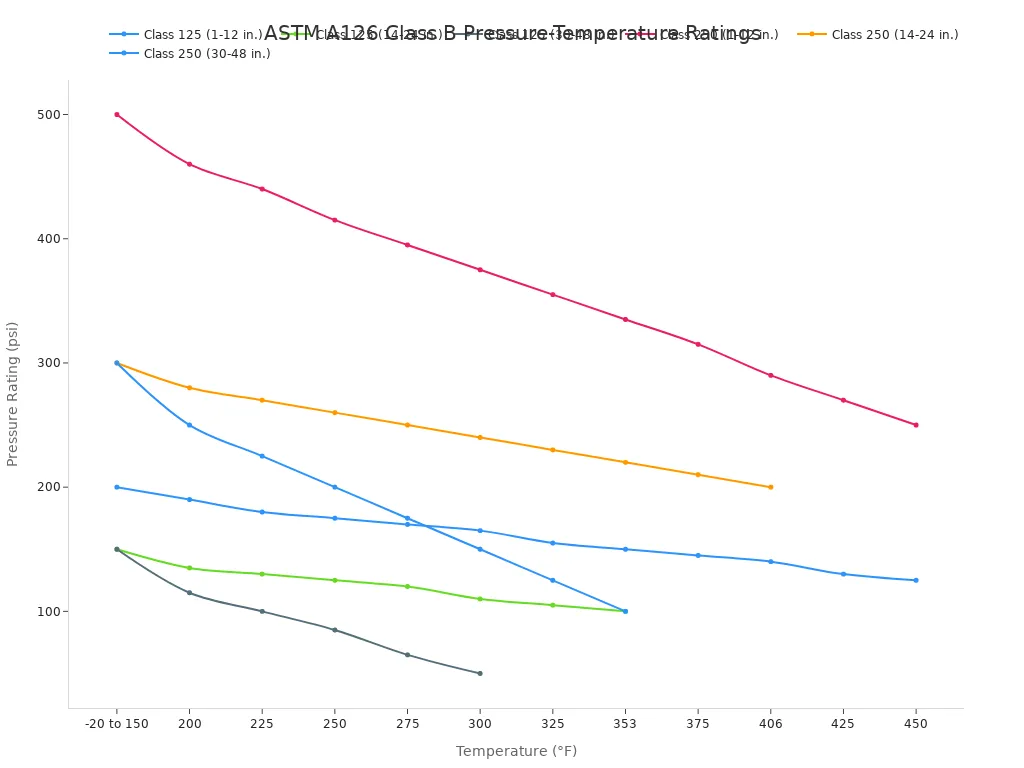
The maximum recommended temperature for cast iron is 200°C. For saturated steam service, the limit is 353°F for Class 125 and 406°F for Class 250. These limits matter because going past them can cause catastrophic failure. Never push a cast iron knife gate valve past its published ratings.
Upgrading Disc Materials for Abrasion Resistance
If your process has abrasive slurries or media that are both corrosive and abrasive, standard cast iron may not be enough. You have two choices: upgrade the body material, or upgrade the disc and seat materials.
Ductile iron knife gate valve bodies fix the brittleness problem. Ductile iron has a minimum tensile strength of 450 MPa and 10% elongation. It can resist at least 7 foot-pounds of impact, while gray cast iron can only resist 2 foot-pounds. Its yield strength is at least 40,000 psi, but gray iron has no measurable yield point. These traits make ductile iron much better for jobs where cast iron bodies might crack from stress or water hammer.
For the disc, choose a stainless steel knife gate valve disc or a hard-faced carbon steel disc. These handle abrasive media much better than standard iron. Hardened stainless steel resists wear from slurries with sand, ore, or ash. The sharper edge also seals better because it cuts through solids instead of crushing them.
TANGGONG VALVE has over 36 years of experience making durable valve solutions for many industries. The company serves clients in oil and gas, petrochemical, power generation, marine, and metallurgy across more than 35 countries.
Ductile iron and carbon steel knife gate valves need anti-corrosion treatment on the surface. Common treatments include fusion-bonded epoxy (FBE) coating and cold treatment processes. These protect the body from rust and chemical attack. They also make the valve last longer in wet or chemically active places. Without a proper coating, even the strongest body material will break down too soon.
Sealing Options for Knife Gate Valves
Your choice of seal decides if a knife gate valve blocks the line or leaks. Most knife gate valves come in two sealing groups. Match the flow direction and seat material to your process.
Unidirectional vs. Bidirectional Sealing
A unidirectional knife gate valve works for flow that only goes one way. The arrow on the body shows the direction. Low pressure makes sealing easier. Installation and upkeep stay simple. You test the closed gate at design pressure. Water and mining slurries often use this type.
Bidirectional seat designs are needed when flow goes backward. Some knife gate valves must handle reverse flow. Wastewater and slurry processing need stronger sealing. Pressure-assisted seats are tested both ways at 40 psi. If the rating is under 40 psi, test at the highest rated pressure. This setup gives you reliable two-way shut-off. A bidirectional knife gate valve gives you full shut-off and safe shut-off.
Resilient Seated vs. Metal Seated Options
A resilient seated knife gate valve uses EPDM, Buna-N, or Viton seats. These elastomers give tight shut-off. A replaceable sleeve lets you renew sealing parts without swapping the whole valve. This type fits lower pressure and mild wastewater. Pick a resilient seated knife gate valve for full flow in city water.
A metal seated knife gate valve handles high heat and harsh slurries. Conditions above PN10 call for metal-to-metal seats. Metal contact gives basic shutoff, not a bubble-tight seal. Use a metal seated knife gate valve for abrasive media.
Both types of knife gate valves use the same body. Choose resilient for lower pressure; choose metal for severe conditions. The goal is steady full flow or shut-off with leakage you can accept. Regular checks keep a knife gate valve working. Many failures come from worn sealing parts. The right seat gives you full shut-off. Make sure the design gives two-way shut-off at rated pressure. In severe service, ask for two-way shut-off from the metal seat version. This careful approach protects your process.
Actuation and Accessories for Your Application
Manual, Electric, or Pneumatic Actuators
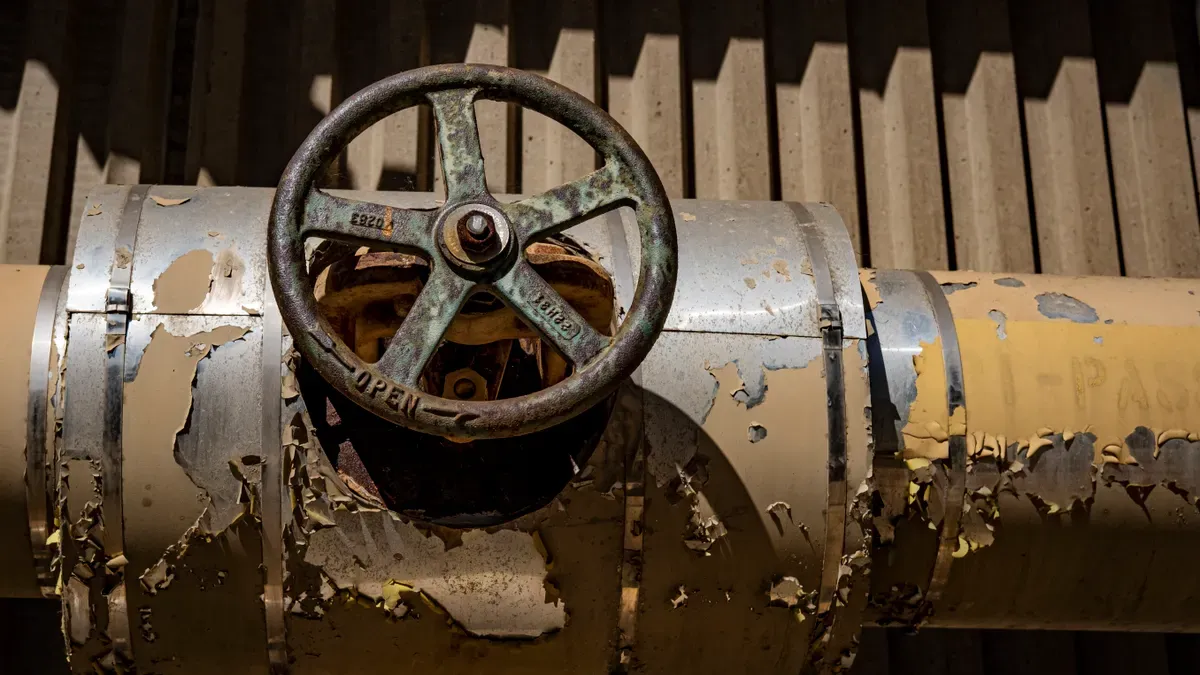
You have three main choices for running your knife gate valve. Each choice fits a different job. Manual actuation works well for simple on/off service. It costs less and needs no outside power. But manual operation is slow. It cannot handle rapid cycling or emergency shutdown.
Pneumatic actuation fits tough conditions. Choose it when you need automated control through PLCs. It also fits when you need fast response for quick operation or emergencies. Pneumatic knife gate valves work well in harsh places with high reliability and low maintenance. They handle media with particles or fibers. Mining, water treatment, chemical, and pulp and paper industries rely on them. Pneumatic actuation allows remote control from a central room. This improves operator safety in hazardous locations.
For pneumatic knife gate valves, gas pressure must be at least 1 MPa. The working range is from 1.0 MPa to 1.6 MPa. If pressure falls too low, the valve may not open or close fully. Sealing performance can suffer. TANGGONG VALVE gives custom solutions for specific needs across many industries.
Packing, Guide Rings, and Flushing Devices
Good packing helps your knife gate valve last longer. OS&Y designs need large rectangular packing. This shape is harder to seal than round stem packing. The open gate gathers debris that wears down the packing over time. Vibration can loosen the large gland area. Dirt on the moving gate makes gland sealing worse in dirty places. Rectangular packing does not compress evenly like round packing. Springs or Belleville washers provide live loading but help only a little. Check and tighten gland packing often to stop leaks and extend valve life.
Gate scrapers and deflector cones protect the packing gland from abrasive media. The self-cleaning design pushes particles off the gate when the valve opens. This cuts down abrasive buildup. A replaceable top packing gland lets you change the seal without taking the valve apart. Guide rings keep the gate aligned for smooth travel and even sealing. Flushing devices clear debris from the seat area. These accessories keep full flow and reliable shutoff. They also reduce wear on your knife gate valve over time.
Coating and Connection Standards
Epoxy Coatings and Lined Options
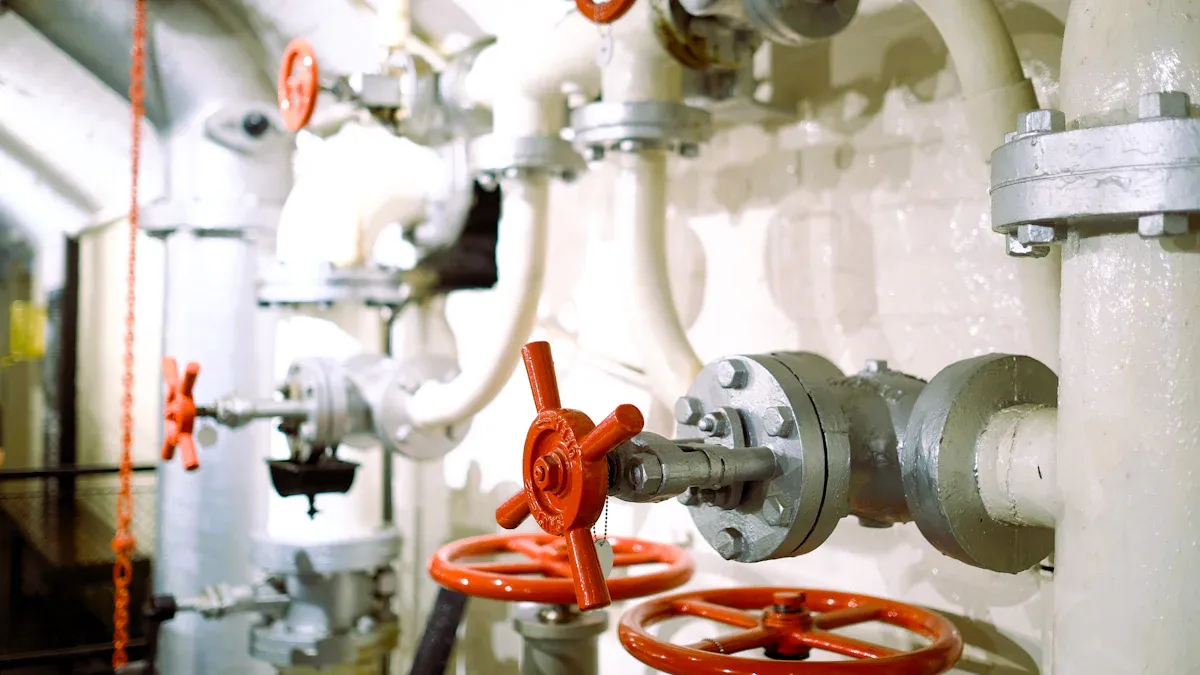
Corrosion wears down iron that has no protection. You need a coating that stops moisture, chemicals, and scraping. Fusion-bonded epoxy (FBE) gives your knife gate valve a strong outer layer. The coating sticks to the iron surface and fights rust in wet or buried service. Wastewater plants and chemical lines depend on this protection every day.
Lined options do even more for harsh media. A rubber or PTFE lining covers the inside wetted surfaces. This barrier keeps corrosive fluids away from the iron body. You get longer service life and steady sealing performance. Pick a lined knife gate valve when your media has acids, chlorides, or strong oxidizers. The lining also lowers friction and helps the gate move smoothly.
Flange Connection Standards and Compatibility
Your knife gate valve must bolt up to existing piping without leaks or stress. Flange drilling standards are different across regions. A DN150 flange could be PN10, PN16, ASME Class 150, or JIS 10K. Each standard uses different bolting patterns. Always check the mating flange before you order.
Many knife gate valves come with drilling that meets multiple international standards. These include ASME B16.5 Class 150, EN 1092-1 PN10 and PN16, BS 4504, DIN, JIS B2220 10K and 16K, and BS 10 Table D and Table E. This flexibility lets you install the same valve in piping systems around the world.
For sizes 2″ through 24″, ASME B16.1 Class 125 (cast iron) and ASME B16.5 Class 150 (steel) flanges use the same drilling template, including bolt circle and hole quantity. However, the exact mating flange standard must always be verified, because a DN150 flange could be PN10, PN16, ASME Class 150, or JIS 10K, each with different bolting.
Face-to-face dimensions also matter for replacements. AWWA C520:2024 covers knife gate valves from 2 in. (50 mm) to 96 in. (2,400 mm), with pressure grades from 25 psig to 150 psig. This standard helps you match a new knife gate valve to your existing space.
Picking the right cast iron knife gate valve begins with your media. Match the valve to slurry conditions, pressure limits, and sealing needs. Wastewater treatment systems need elastomer compatibility checks.
Knife gate valves fit many industries. But every knife gate valve needs careful checking. A cast iron knife gate valve works best for low-pressure, non-corrosive service. You must verify each knife gate valve you buy. Ask for test records, material certificates, and production photos. Check the pressure-temperature table, coating records, and elastomer compatibility. Confirm the sealing design and actuation method for each knife gate valve. When unsure about pressure ratings or chemical compatibility, ask a specialist. Reliable manufacturers explain standards and traceability.
FAQ
What Is the Difference Between a Knife Gate Valve and a Standard Gate Valve?
A knife gate valve has a thin, sharp blade that cuts through media. Standard gate valves push media aside. The cutting action stops clogging in slurries, pulp, and wastewater. Standard gate valves fit clean fluids only. Your media type tells you which to pick.
Can Cast Iron Handle Abrasive Slurries?
Standard cast iron cracks under heavy stress. For abrasive slurries, pick a ductile iron body with a hardened stainless steel disc. Ductile iron resists 7 foot-pounds of impact. Cast iron resists only 2 foot-pounds. Surface coatings like fusion-bonded epoxy also shield the body from wear and corrosion.
How Do I Choose Between Resilient and Metal Seats?
Resilient rubber seats seal tightly for clean water and wastewater. Metal seats handle high heat and harsh slurries, but may leak slightly. Pick a seat that matches your media. Choose resilient for zero visible leakage in city service. Choose metal for abrasives.
What Pressure Limits Apply to Cast Iron Bodies?
From sizes 1 to 12 inches, ASME Class 125 cast iron bodies handle 200 psi at temperatures from -20°F to 150°F. Larger sizes drop to 150 psi. At 300°F, the smaller valve rates 165 psi. Always check the pressure-temperature table before installation.
What Flange Standards Fit a Cast Iron Knife Gate Valve?
Many knife gate valves have multi-standard drilling. Common choices are ASME B16.5 Class 150, EN 1092-1 PN10 and PN16, and JIS B2220 10K. A DN150 flange may fit several standards. Check the bolting pattern against your existing piping before you order.